
Empty can test (supraspinatus test)
The patient raises the arm to 90 degrees abduction and horizontally adducts the arm 30 degrees (in the scapular plane). The shoulder is internally rotated so that the thumb points down. The examiner then applies a downward pressure to get an impression of the strength output and whether the examination triggers pain.

Execution of the test
- First abduct the arm to 90° with the thumb up ("Full Can"), check strength
- Then perform the "Empty Can" test
- A positive test indicates M. supraspinatus rupture, alternatively injury (compression or neuropathy) in N. suprascapularis
- A positive test is more pronounced weakness and/or pain in the "Empty Can" position compared to the arm in the "Full Can" position
Test characteristics: Sens 64, Spec 65, LR+1.83, LR-0.55
M. supraspinatus rupture
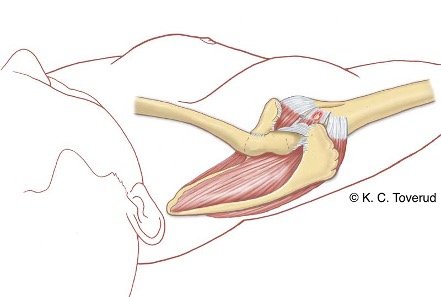
- Rupture in the M. supraspinatus tendon usually occurs as a result of wear and degenerative changes in the tendon tissue
- A torn M. supraspinatus tendon is not necessarily very painful, but pain may still be present during specific movements, especially abduction