
O’Brians test (The active compression test) for 'upper, anterior labral injuries'
Standing with the arm in 90º flexion, 10-15º adducted relative to the sagittal plane and with internal rotation so that the thumb points downwards. The examiner stands behind and applies a steady downward pressure that the patient is to resist. With the arm in the same position, the test is repeated, but the patient now has the palm up and full external rotation.
Arms held in 90° flexion and 15° adduction, thumb pointing down
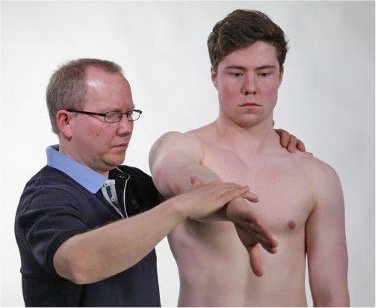
Test characteristics: Sens 63, Spec 53, LR+1.3, LR-0.70
The test is positive if the patient experiences pain during the first part of the test and reduced or no pain during the second part. Pain or clicking “inside” the joint indicates a labral injury. Pain mainly “on top” of the shoulder indicates AC joint pathology.
Arms in the same position but now with the palm supinated

Labral injury, SLAP lesion
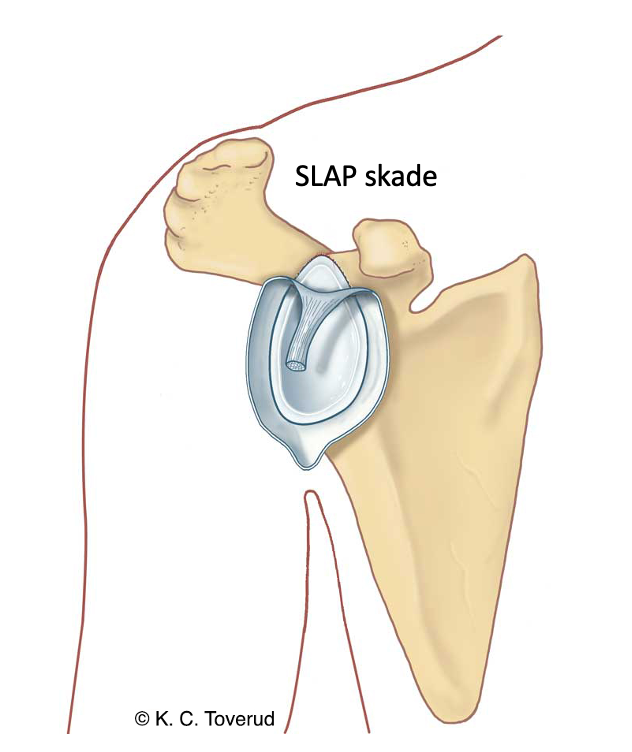
- Tear in the upper part of the glenoid labrum where the biceps tendon transitions into the labrum before attachment on the superior tubercle of the glenoid fossa
- The tear extends from the anterior to the posterior part of the labrum
- S=Superior
- L=Labrum
- AP=Anterior Posterior
Mechanism of injury and clinical presentation
Fall on an outstretched arm, fall directly on the shoulder, strong jerk in the arm, weight training, heavy lifting. Athletes, throwers. Often only painful when performing a throwing motion. In work, repetitive work with the arm overhead. Pain upwards/backwards in the shoulder. Clicking and slipping in the joint. Shoulder gets tired faster. Feeling of instability. Some complaints of night pain.