
N. ulnaris, anatomy
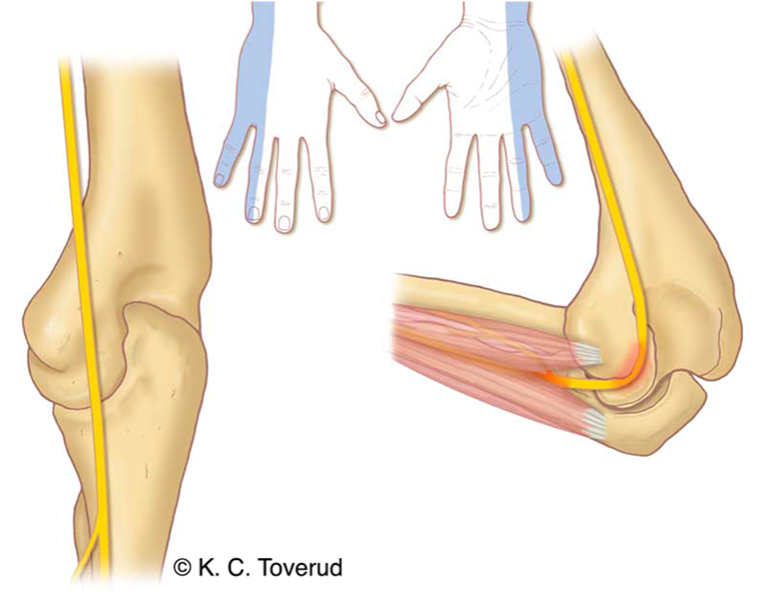
- Goes down the upper arm ulnarly and passes the elbow in the ulnar sulcus
- Passes the forearm ulnarly and enters the hand in Guyon’s canal
N. ulnaris, motor function
- Flexion and ulnar deviation of the wrist (M. flexor carpi ulnaris)
- Flexion of the 4th and 5th fingers (M. flexor digitorum profundus)
- Thumb adduction (M. adductor pollicis)
- Thumb flexion (M. flexor pollicis brevis, deep head)
- Abduction and adduction of fingers (M. interossei dorsales et palmares)
- Flexion of MCP of 4th and 5th finger (Mm. lumbricales)
- Extension of PIP and DIP of 4th and 5th finger (Mm. lumbricales)
- Little finger abduction (M. abductor digiti minimi), opposition (M. opponens digiti minimi) and MCP flexion (M. flexor digiti minimi brevis)
- Contraction of palmar aponeurosis (M. palmaris brevis)
Ulnar nerve, sensory function
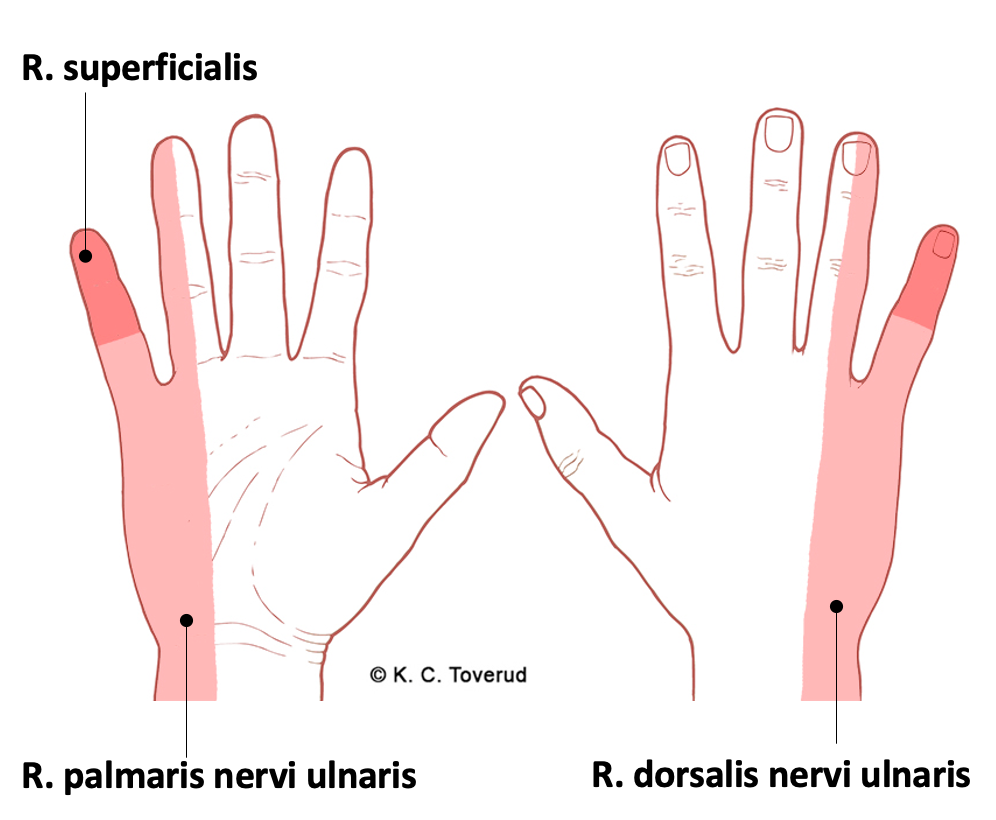
Three sensory branches
- R. palmaris of the ulnar nerve which supplies the hypothenar area in the palm
- R. dorsalis of the ulnar nerve which supplies the ulnar area dorsally
- R. superficialis which supplies half of the 4th finger and the entire 5th finger
Cubital tunnel syndrome, causes
- Pressure injury
- Entrapment of the nerve between the origins of M. flexor carpi ulnaris on the ulna and humerus
- Fracture of the medial epicondyle
- Supracondylar humerus fracture
Cubital tunnel syndrome, Tinel test
Tapping on the ulnar nerve
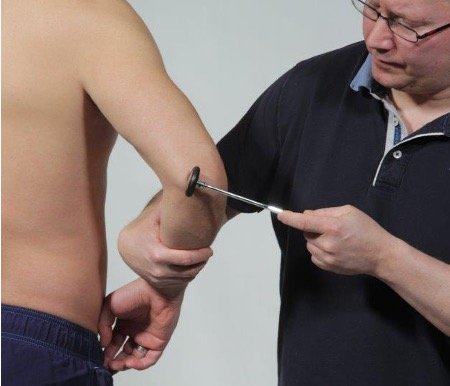
Records whether tingling, pricking, or pain radiates along the ulnar forearm?
Test characteristics: Sens 70, Spec 98, LR+35, LR-0.31
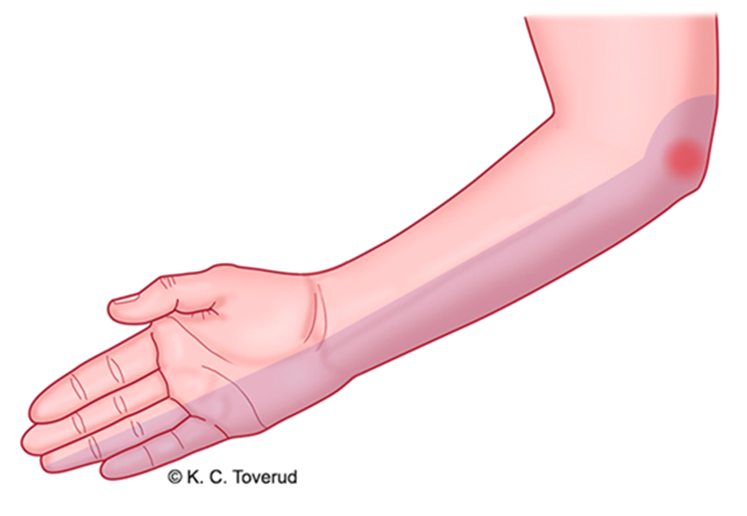
Pain medially in the elbow with a tendency to radiate along the ulnar forearm and out ulnarly in the hand may be caused by cubital tunnel syndrome, i.e., entrapment of the ulnar nerve in the ulnar sulcus. In addition to sensory disturbances in the ulnar area, patients may also have weakness in the hand muscles innervated by the ulnar nerve. With clinical suspicion, Tinel's test over the ulnar nerve in the ulnar sulcus can often be positive.
Cubital tunnel syndrome, motor deficits
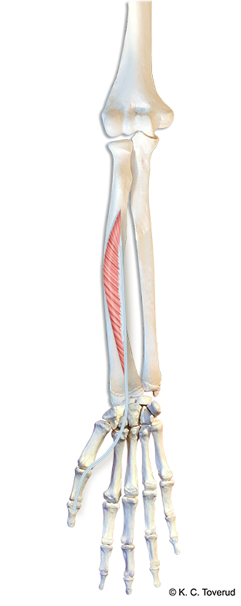
- Weakness of M. flexor carpi ulnaris and the ulnar half (4th and 5th fingers) of M. flexor digitorum profundus
- Flexion in the wrist is possible, but radial deviation in the wrist occurs simultaneously
- Weakened power of flexion in the DIP joints of the 4th and 5th fingers
- Weakness in the two ulnar lumbricals (lumbrical 3 and 4), interossei, and M. flexor digiti minimi brevis
- Flexion in the MCP joint of the 4th and 5th fingers is weakened
- Extension in the PIP and DIP joints of the 4th and 5th fingers is weakened, and the fingers remain in slight flexion
- The normal strength of M. extensor digitorum and M. extensor digiti minimi (innervated by the radial nerve) causes the MCP joints to go into hyperextension
- Weakness of the interossei
- Abduction and adduction in the fingers are weakened
- Weakness in M. adductor pollicis
- Adduction in the thumb is weakened, resulting in a positive Froment’s sign
Cubital tunnel syndrome, claw hand
Try to open the hand!

When an attempt is made to open the hand we get
- Hyperextension in MCP of 4th and 5th finger
- Partial flexion in the DIP and PIP joints of the 4th and 5th fingers
- “The ulnar paradox”
- In cubital tunnel syndrome, M. flexor digitorum profundus is also weakened. This results in less flexion in the DIP joints of the 4th and 5th fingers and a less pronounced claw hand.
- The degree of claw hand with proximal nerve injury is therefore less than with injury in the wrist area,
- In ulnar tunnel syndrome, the M. flexor digitorum profundus is intact and flexion in the DIP joints of the 4th and 5th fingers is then greater, making the claw hand more pronounced.
Cubital tunnel syndrome, Froment's sign
Try to hold back the paper!
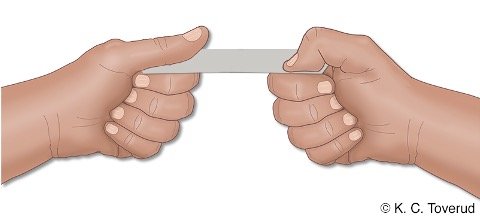
- M. adductor pollicis weakness
- Weak thumb adduction
- M. flexor pollicis longus has normal strength (innervated by N. interosseus anterior, branch of N. medianus)
- Flexion in the thumb’s interphalangeal (IP) joint is normal.
- The IP joint is flexed to hold the paper.
Froment’s sign
Weakness in M. adductor pollicis, innervated by N. ulnaris C8-Th1
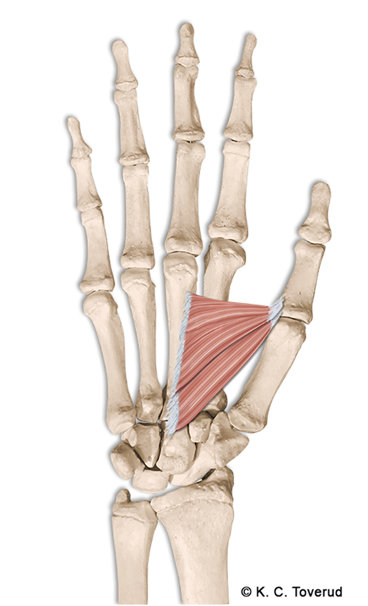
Normal strength in M. flexor pollicis longus, innervated by N. medianus C8-Th1
Cubital tunnel syndrome, sensory deficits
Pain and numbness in the ulnar forearm from elbow to hand
sensory loss corresponding to all three sensory branches of the ulnar nerve
Key diagnostics, ulnar nerve
